

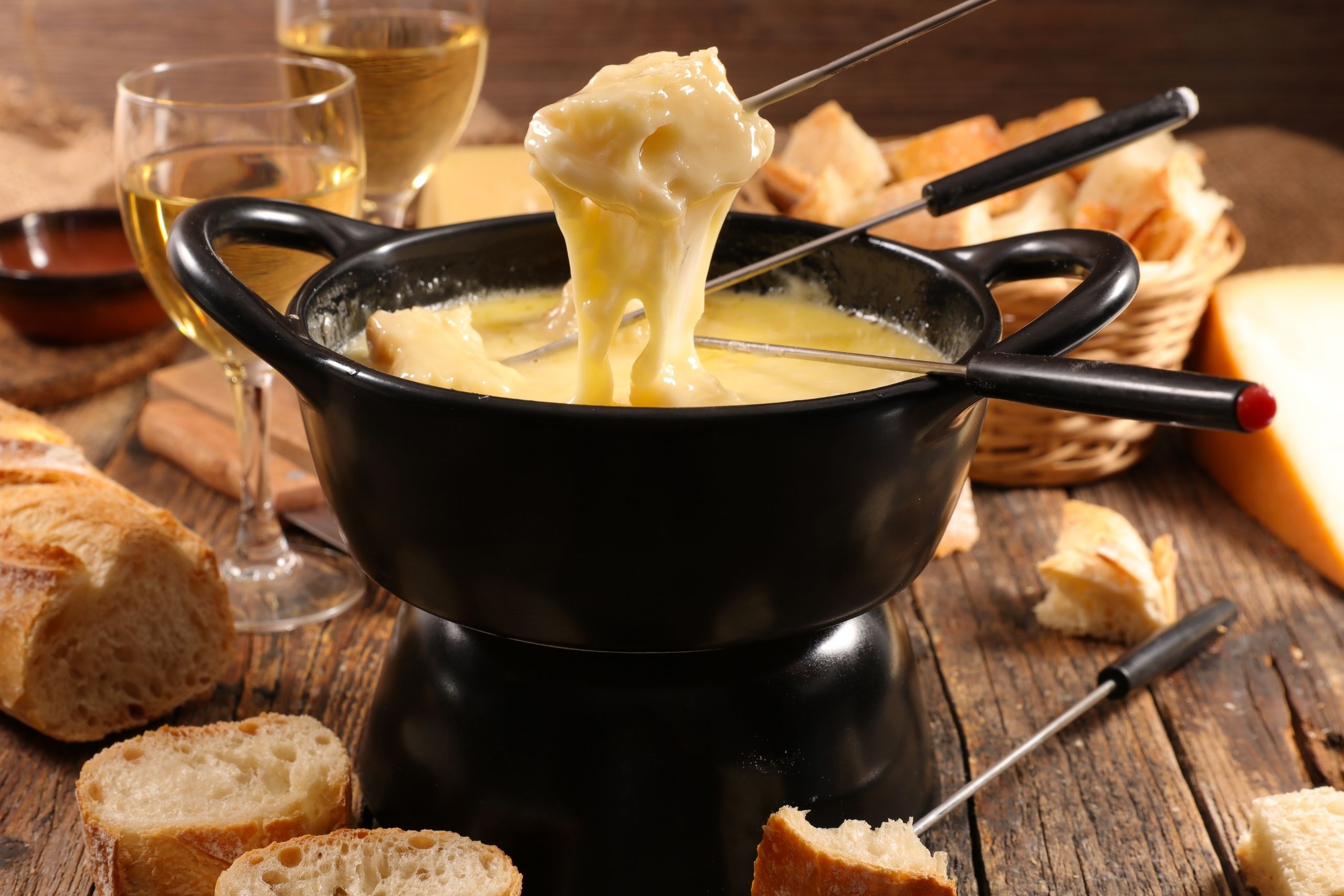
A comforting Alpine tradition, it’s history, the cheeses that make it unforgettable, the wines that bring it to life… and why no two Savoyard families ever agree on the perfect recipe.
In this guide you’ll discover
✓ What makes Savoyard fondue different
✓ The history behind this Alpine classic
✓ Which cheeses create the best fondue
✓ Our own Cheese Forever recipe
✓ The best wines to serve with fondue
✓ Traditional cooking tips
✓ A few local traditions you probably didn’t know about
More than melted cheese…
If you’re visiting Chamonix, there’s one dish you simply have to try.
No, not because it’s famous.
Because it perfectly captures the spirit of the Alps.
Savoyard fondue isn’t just melted cheese.
It’s an evening that lasts longer than expected.
It’s friends gathered around the table.
It’s stories, laughter and the comforting smell of warm cheese filling the room.
And, if we’re being honest…
It’s probably one of the most delicious excuses ever invented for opening a good bottle of wine.
Let’s clear something up first…
Not every fondue is Swiss. 😉
It’s probably the biggest misconception about one of the Alps’ most iconic dishes.
Yes, Switzerland has its own wonderful fondue traditions. But here in Savoie, just across the border, cheese fondue has been warming mountain evenings for generations, becoming an essential part of Alpine life.
And if you ask anyone in Savoie how to make the perfect fondue…
Be prepared for a long discussion.
Because every family has its own recipe.
Every village has its own opinion.
And every cheesemonger secretly believes theirs is the best.
We certainly do.
🇫🇷 French words you’ll hear…
Savoie
A historic Alpine region in south-eastern France, famous for its mountains, cheeses and wines. Although often associated with Switzerland, Savoie has its own rich culinary traditions.
More than a meal
One of the things we love most about fondue is that it’s impossible to rush.
Unlike so many meals today, fondue asks you to slow down.
The cheese takes its time to melt.
The conversation naturally becomes longer.
The bottle of wine somehow empties itself.
Someone inevitably drops their bread into the pot.
Everyone laughs.
Before you know it, two hours have gone by.
That’s exactly what fondue is supposed to do.
It’s never just about melted cheese.
It’s about sharing an evening together.
🍷 A little note from Emily
“The first time I had a proper Savoyard fondue, I thought the cheese would be the highlight.
I was completely wrong.
It was everything that happened around the table that made me fall in love with it.“
— Emily
🧀 Cheese Forever Tip
Use yesterday’s bread if you can.
Slightly stale bread holds together much better than fresh bread, making it far less likely to disappear into the fondue.
A little history
Although melted cheese has existed in mountain regions for centuries, the fondue we know today gradually took shape in the Alps, where long winters encouraged people to make the most of simple ingredients that kept well.
Hard cheeses, bread and local white wine were always close at hand.
Bringing them together in a single pot was both practical and wonderfully comforting.
Over time, fondue became much more than an economical meal.
It became a tradition.
Today, it remains one of the great symbols of Alpine hospitality, bringing friends and family together around the same pot, whether in a mountain chalet, a village home or after a day on the slopes.
🇫🇷 French words you’ll hear…
Chalet
Originally, a mountain farmhouse used by shepherds during the summer months.
Today, the word has become synonymous with cosy Alpine living all over the world.
Which cheeses make a traditional Savoyard fondue?
If there’s one thing everyone agrees on…
It’s that there is no single “official” recipe.
Depending on the valley, the village—or even the family—you’ll find different combinations.
The most common cheeses include:
- Beaufort AOP
- Comté
- Gruyère
- Abondance
- Emmental (in some traditional recipes)
The important thing isn’t following one exact recipe.
It’s choosing beautifully matured cheeses with plenty of flavour.
That’s where a good cheesemonger makes all the difference.
🇫🇷 French words you’ll hear…
Affineur
A cheesemaker creates cheese.
An affineur patiently matures it until it reaches its full potential.
In France, choosing the right affineur is just as important as choosing the right cheese.
Our Cheese Forever Fondue
Our recipe
At Cheese Forever, we prepare our own fondue blend every single day.
Not because we wanted to reinvent tradition.
Quite the opposite.
Like every family in Savoie, we’ve simply created the recipe we most enjoy sharing around our own table.
Our blend
🧀 ⅓ Beaufort AOP
From the Bourg-Saint-Maurice Cooperative.
Rich, fruity and beautifully elegant.
🧀 ⅓ Extra Comté (aged for at least 14 months)
Deep, nutty flavours that add remarkable complexity.
🧀 ⅓ Gruyère Réserve
Silky, creamy and wonderfully smooth.
Together, they create a fondue that’s rich, perfectly balanced and full of character.
Is it the traditional Savoyard recipe?
Not exactly.
Is it the one we’d proudly serve to our friends?
Absolutely.
🧀 Cheese Forever Tip
Take your fondue out of the fridge about an hour before cooking.
🍷 A little note from Emily
I’ve never met two Savoyard families who completely agree on the perfect fondue recipe…
…and I sincerely hope I never do.
— Emily
Which wine goes best with Savoyard fondue?
One of the questions we’re asked most often is:
“Can I use any white wine for fondue?”
Technically…
Yes.
But if you’ve gone to the trouble of choosing beautiful cheeses, why not give them the wine they deserve?
A good fondue should taste balanced.
The wine shouldn’t dominate the cheese.
It should simply lift it, bringing freshness and elegance to every bite.
That’s why dry white wines are almost always the best choice.
Our favourite wines from Savoie
If you’re enjoying a proper Savoyard fondue, it makes perfect sense to stay local.
The vineyards of Savoie produce wonderfully fresh, mineral white wines that pair beautifully with melted cheese.
Our favourites include:
🍷 Chignin
Probably our first choice.
Made mainly from the Jacquère grape, Chignin offers crisp acidity, delicate floral aromas and plenty of freshness.
Exactly what a rich, creamy fondue needs.
🍷 Jongieux Jacquère
Slightly rounder while keeping the lively freshness typical of Jacquère.
A wonderfully food-friendly wine that lets the cheeses remain the stars of the evening.
🍷 Apremont
Another classic Savoyard favourite.
Fresh, light and incredibly easy to enjoy.
Perfect if you prefer a more delicate style of fondue.
🍷 A little note from Emily
People often ask us whether the wine goes into the fondue or into the glass.
Our answer is always the same…
Both.
— Emily
How much wine should you add?
The exact amount depends on the cheeses you’re using and the consistency you enjoy.
As a general guide:
- Around 150 ml of dry white wine for 400 g of cheese is a great place to start.
You can always add a splash more if your fondue feels too thick.
It’s much easier than trying to thicken one that’s become too runny.
The goal is simple:
A fondue that slowly coats your bread…
Not one that pours like soup.
Can you make fondue without wine?
Technically…
Yes.
Should you?
Well… that’s another conversation. 😉
Wine isn’t there simply for flavour.
Its natural acidity helps the cheese melt smoothly and gives the fondue the freshness that keeps every bite delicious from beginning to end.
If you really don’t want to cook with wine, a little unsweetened apple juice or a light stock can work.
The result, however, will be noticeably different.
If you’re trying Savoyard fondue for the very first time…
We’d encourage you to experience it the traditional way.
After all, traditions usually exist for a reason.
Choosing the right pot
The cheese might be the star of the evening…
But your caquelon deserves a little credit too.
A traditional ceramic or cast-iron fondue pot distributes the heat gently and evenly, helping the cheese stay beautifully smooth throughout the meal.
Whichever pot you choose, the secret is simple:
Low heat.
Patience.
And plenty of stirring.
Fondue has never liked being rushed.
🍷 A little note from Emily
We’ve seen people trying to make fondue in all sorts of pans over the years…
Let’s just say a proper fondue pot makes life considerably easier!
— Emily
How to cook the perfect Savoyard fondue
Making a great fondue isn’t difficult.
In fact, it’s surprisingly simple.
The secret isn’t having a complicated recipe.
It’s taking your time.
A little patience makes all the difference.
What you’ll need
For a traditional Savoyard fondue, you’ll need:
- A caquelon (traditional fondue pot)
- A fondue burner
- Long fondue forks
- Good crusty bread
- A wooden spoon
- A bottle of dry white wine
Simple.
After all, fondue has always been about making the most of a few wonderful ingredients.
🇫🇷 French words you’ll hear…
Caquelon
Pronounced roughly: ka-ke-lon.
The traditional ceramic or cast-iron pot used to prepare and serve fondue.
It’s one of those lovely French words you’ll probably hear during your stay in the Alps.
Step 1 – Rub the pot with garlic
Cut a garlic clove in half and rub the inside of the caquelon.
You can leave the garlic inside if you enjoy a stronger flavour, or simply remove it afterwards.
It’s a tiny detail.
But it’s one of those little rituals that almost every family keeps.
🧀 Cheese Forever Tip
Don’t skip this step.
It takes less than a minute but adds a delicate background flavour without overpowering the cheeses.
Step 2 – Add the wine
Pour your dry white wine into the caquelon.
Heat it gently.
Never let it boil.
A slow start gives the cheeses time to melt smoothly.
Step 3 – Add the cheese gradually
Add the grated cheese little by little.
Keep stirring gently.
The fondue should become smooth, silky and glossy.
Not stringy.
Not grainy.
Just beautifully creamy.
🍷 A little note from Emily
“People often think fondue is difficult to make.
Honestly… it’s usually impatience that’s the problem.
Good fondue likes people who slow down.”
— Emily
Step 4 – Keep stirring
Traditionally, people in Savoie stir in a figure of eight rather than simply going around in circles.
Does it really make a difference?
You’ll hear passionate arguments on both sides.
We’ll let you decide.
🧀 Cheese Forever Tip
Never stop stirring while the cheese is melting.
It’s the easiest way to achieve a perfectly smooth texture.
What should you dip into Savoyard fondue?
Bread is the obvious answer.
And probably still the best one.
But that’s far from the only possibility.
Bread
Probably our first choice.
Made mainly from the Jacquère grape, Chignin offers crisp acidity, delicate floral aromas and plenty of freshness.
Exactly what a rich, creamy fondue needs.
🧀 Cheese Forever Tip
Cut your bread into generous cubes.
Tiny pieces disappear into the fondue surprisingly quickly…
Potatoes
A favourite throughout the Alps.
Especially if you’re serving charcuterie alongside your fondue.
Charcuterie
Cured ham.
Coppa.
Speck.
Saucisson.
Simple, delicious and wonderfully Savoyard.
🍷 A little note from Emily
People often ask us whether the wine goes into the fondue or into the glass.
Our answer is always the same…
Both.
— Emily
Vegetables
Steamed cauliflower.
Broccoli.
Baby potatoes.
Even mushrooms.
Perhaps not entirely traditional…
But undeniably delicious.
Fruit?
Now we’re entering dangerous territory… 😉
Some people enjoy slices of pear or apple with fondue.
Others would consider this almost sacrilegious.
Like so many things in Savoie…
You’ll find plenty of opinions.
🍷 A little note from Emily
“One of the nicest things about fondue is that nobody ever seems to eat it exactly the same way.
That’s probably why everyone is convinced their family does it best.”
— Emily
The little traditions
One of the reasons we love fondue so much is that every family seems to have invented its own little rituals.
Some are wonderfully serious.
Others…
Perhaps not quite so much.
Losing your bread
Drop your bread into the fondue and you’ll almost certainly hear someone announce a “traditional penalty.”
What that penalty is…
Depends entirely on who’s sitting around the table.
Don’t forget la religieuse
As the meal comes to an end, a golden crust forms at the bottom of the caquelon.
In France, this is called la religieuse.
Many fondue lovers consider it the very best part of the meal.
One last surprise…
In many Savoyard families, the evening doesn’t end with the last piece of bread.
Instead, an egg is cracked directly into the warm caquelon, where it gently cooks with the last spoonfuls of melted cheese.
A little pepper.
Perhaps a pinch of nutmeg.
Sometimes fresh herbs.
It’s wonderfully simple…
…and a delicious way to make sure not a single bit of cheese goes to waste.
Like so many Alpine traditions, every family does it slightly differently.
🇫🇷 French words you’ll hear…
La religieuse
Literally, “the nun.”
It’s the delicious golden crust that forms at the bottom of the caquelon once the fondue is almost finished.
For many people…
It’s worth saving room for.
🍷 A little note from Emily
“The first time someone proudly told me we were about to eat “the nun”, I genuinely had no idea what was happening…
Five minutes later… I completely understood.”
— Emily
A final thought…
There are probably as many fondue recipes as there are grandmothers in Savoie.
That’s exactly what makes fondue so special.
Traditions are meant to be shared…
Not standardised.
Whether you choose a classic recipe or our own Cheese Forever blend, we hope your fondue becomes one of those meals people remember long after the last piece of bread has disappeared.
Because, in the end…
The best fondue isn’t necessarily the most traditional.
It’s the one shared with the people you love.
Frequently Asked Questions
Is Savoyard fondue French or Swiss?
Both France and Switzerland have their own wonderful fondue traditions.
Savoyard fondue comes from the French Alps and is traditionally made with local mountain cheeses such as Beaufort, Comté, Abondance or Gruyère, depending on the family recipe.
Like many great regional dishes, there isn’t just one “correct” version.
Which cheese is best for fondue?
The best fondue always starts with beautifully matured cheeses.
At Cheese Forever, our own blend combines:
- ⅓ Beaufort AOP
- ⅓ Extra Comté (aged for at least 14 months)
- ⅓ Gruyère Réserve
It produces a wonderfully creamy fondue with plenty of character while remaining beautifully balanced.
Can I prepare the cheese in advance?
Absolutely.
In fact, that’s exactly what many of our customers do.
Our freshly grated fondue blend can simply be kept in the refrigerator until you’re ready to cook.
It saves time…
…and guarantees the perfect balance of cheeses every single time.
Can I freeze fondue cheese?
Yes.
Our fondue blend freezes very well.
Simply thaw it slowly in the refrigerator before cooking.
Which wine goes best with Savoyard fondue?
Dry white wines from Savoie are always our first choice.
We particularly enjoy:
- Chignin
- Jongieux Jacquère
- Apremont
Their freshness and lively acidity perfectly complement the richness of the cheese.
Can I make fondue without wine?
Yes, although the result will be different.
Wine adds freshness, balance and helps create a beautifully smooth texture.
If you prefer not to use wine, unsweetened apple juice or a light stock can be used instead.
How much cheese should I allow per person?
As a general guide:
- 200 to 250 g of cheese per person
If everyone has spent the day skiing or hiking around Chamonix…
We’d probably recommend the higher end! 😉
🍷 A little note from Emily
“We’ve learned one thing over the years…
People who’ve spent the day in the mountains are usually hungrier than they think!”
What should I serve with fondue?
A traditional Savoyard fondue is usually served with:
- Country bread
- Charcuterie
- Small potatoes
- Cornichons
- Pickled onions
- A crisp green salad
Simple accompaniments allow the cheeses to remain the stars of the meal.
What’s the best fondue pot?
A traditional ceramic or cast-iron caquelon remains the best choice.
It distributes heat evenly and helps keep the fondue smooth throughout the meal.
Why did my fondue become grainy?
Usually because it became too hot.
Fondue loves gentle heat.
Take your time.
Stir continuously.
Never allow it to boil.
Patience is one of the secret ingredients.
What happens if someone drops their bread?
Congratulations.
You’ve just started a family debate.
Every household seems to have invented its own “penalty”.
Some buy the next bottle of wine.
Some do the washing up.
Some simply laugh and carry on eating.
There are no official rules…
Only family traditions.
Can I visit Cheese Forever if I know nothing about French cheese?
Please do.
Honestly, those are some of our favourite conversations.
Tell us what you usually enjoy eating or drinking, and we’ll help you discover something you’ll love.
No complicated jargon.
No intimidating cheese counters.
Just good food, good conversation and a warm welcome.
🍷 A little note from Emily
“I still remember walking into French cheese shops for the very first time.
So if you’re feeling a little overwhelmed… don’t worry.
I’ve been exactly where you are.”
Before you leave…
Planning to make fondue during your stay in Chamonix?
Pop into Cheese Forever.
We’ll happily recommend the right cheeses, the perfect wine and answer any questions you might have.
No appointment needed.
Just bring your curiosity… and your appetite.
🧀 Discover more French classics
If you enjoyed this guide, you might also like:
Cheese & Wine Tastings in Chamonix
Leave a Reply