

The cheese, the traditions, the wine… and why raclette is one of the happiest meals you’ll ever share.
In this guide you’ll discover
✓ What raclette really is
✓ Why the cheese matters more than the machine
✓ How to choose the best raclette cheese
✓ Why raw milk changes everything
✓ Which wines pair beautifully
✓ The best potatoes and charcuterie
✓ Traditional Alpine customs
✓ Cheese Forever tips from behind the counter
More than melted cheese…
Imagine you’ve spent the day skiing beneath Mont Blanc.
Or hiking through alpine meadows.
Your cheeks are glowing.
Your boots are by the door.
Someone places a raclette grill in the middle of the table.
Small potatoes.
A selection of charcuterie.
A crisp green salad.
A bottle of chilled white wine.
Then the cheese starts to melt.
Suddenly…
Nobody is looking at their phone anymore.
Everyone is talking.
Laughing.
Cooking their own little pan of cheese.
Going back for “just one more.”
That’s raclette.
Not simply a meal.
One of the friendliest traditions in the French Alps.
What exactly is raclette?
If you’ve never tried raclette before, don’t worry.
It’s beautifully simple.
Raclette is both the name of a cheese…
…and the meal built around it.
The name comes from the French verb racler —
“to scrape.”
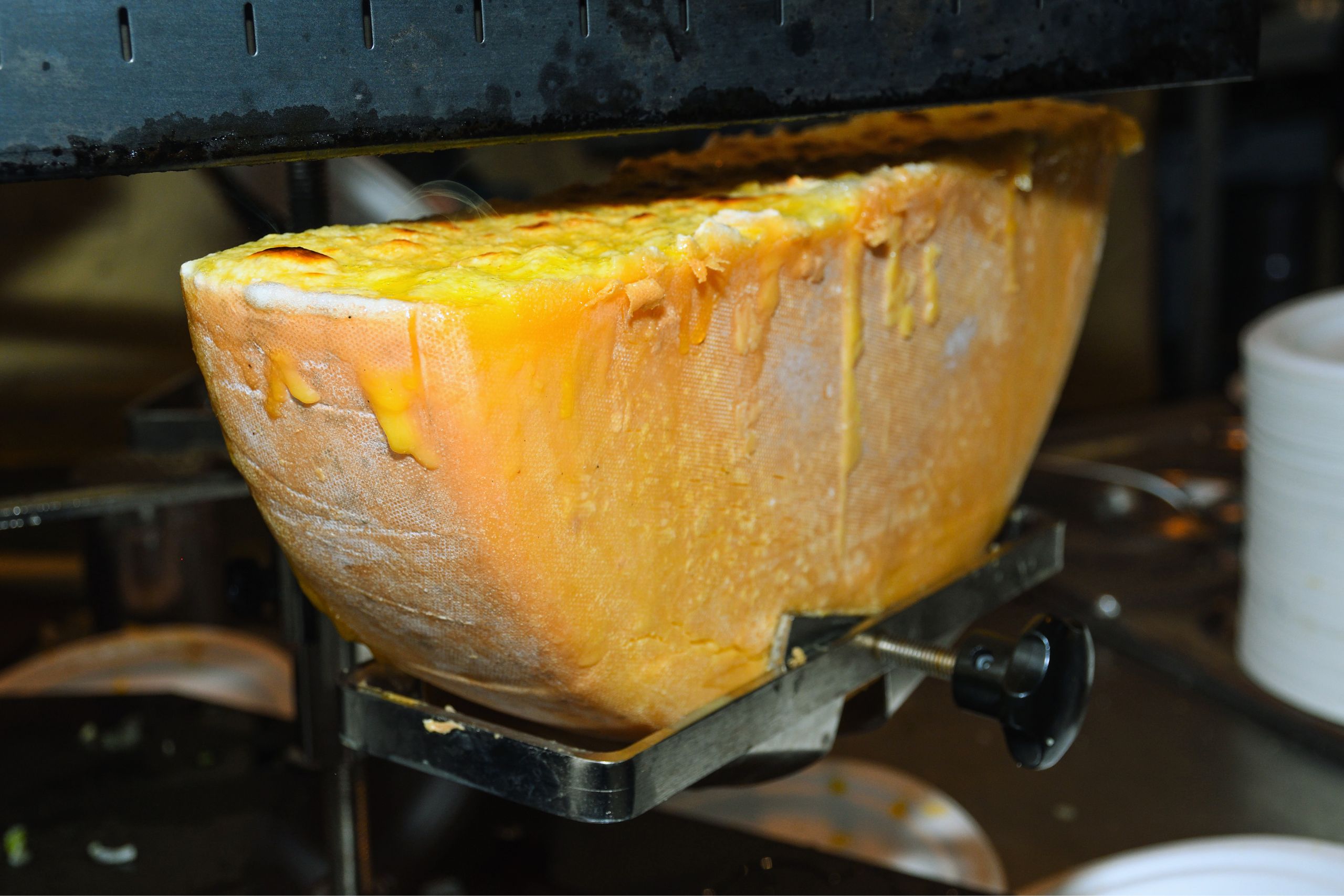
Traditionally, a large wheel of cheese was placed beside an open fire.
As the surface slowly melted, the cheesemaker scraped the bubbling cheese directly onto potatoes, cured meats and bread.
The idea was wonderfully simple.
Take a few exceptional ingredients.
Do almost nothing to them.
Enjoy them together.
More than a century later…
We’re still doing exactly that.
🇫🇷 French words you’ll hear…
Racler
One of our favourite French verbs.
It simply means “to scrape.”
That’s exactly how traditional raclette is served: the melted cheese is scraped from the wheel straight onto your plate.
Sometimes the simplest words tell the best stories.
More than a meal
One of the reasons we love raclette so much is that everybody cooks at their own pace.
Nobody disappears into the kitchen.
Nobody spends the evening serving everyone else.
The grill sits in the middle of the table.
Conversation comes naturally.
Everyone melts their own cheese.
Some people carefully prepare every little pan.
Others simply keep adding another slice.
Neither approach is wrong.
Raclette has never been about perfection.
It’s about being together.
🍷 A little note from Emily
“I’ve never met anyone who’s said, ‘I wish we’d eaten less raclette and talked less.’
Some meals simply have a way of slowing life down.
Raclette is definitely one of them.”
— Emily
A little history
Like many of the Alps’ greatest dishes, raclette began as simple mountain food.
Shepherds and farmers needed meals that were nourishing, practical and made from ingredients they always had on hand.
Cheese.
Potatoes.
Bread.
Charcuterie.
The large wheel of cheese was warmed beside the fire and scraped onto whatever was available.
Simple food.
Exceptional ingredients.
That philosophy hasn’t changed very much.
The cheese comes first
Many people spend hours choosing the perfect raclette machine.
We think they’re asking the wrong question.
The most important decision you’ll make isn’t the grill.
It’s the cheese.
A beautifully matured raclette cheese will transform the evening.
Even the most expensive machine can’t rescue an average cheese.
⭐ From the Cheesemonger’s Counter
Raw milk makes all the difference
Whenever possible, we recommend raclette made from raw milk.
Why?
Because raw milk preserves the natural complexity of the cheese.
You’ll discover more aroma.
More depth.
More character.
As the cheese matures, those flavours continue to develop, giving every slice a richness that’s impossible to recreate afterwards.
Pasteurised raclette melts perfectly well.
But if you want to experience raclette as generations of Alpine cheesemakers intended…
Raw milk is where the journey begins.
Why ageing matters
Not all raclette cheeses taste the same.
And they shouldn’t.
A younger raclette is wonderfully creamy and delicate.
A more mature cheese develops deeper, nuttier flavours and a firmer texture.
Neither is better.
They’re simply different.
That’s one of the pleasures of visiting a real cheesemonger.
We don’t ask:
“Which raclette would you like?”
We ask:
“What kind of raclette evening are you hoping to have?”
🇫🇷 French words you’ll hear…
Affineur
A cheesemaker creates cheese.
An affineur patiently matures it until it reaches its full potential.
In France, choosing the right affineur is just as important as choosing the right cheese.
Our favourite raclette cheeses
The classic choice will always be traditional Raclette cheese.
Creamy.
Balanced.
Wonderfully comforting.
Exactly what raclette should be.
But part of the fun is discovering different styles.
Depending on your taste, we might recommend:
- Traditional Raw Milk Raclette
- Farmhouse Raclette
- Smoked Raclette
- Wild Garlic Raclette
- Pepper Raclette
- Morbier for a slightly bolder flavour
Because every raclette evening deserves its own personality.
🧀 Cheese Forever Tip
Take your cheese out of the refrigerator about an hour before dinner.
Room-temperature cheese melts more evenly, develops more flavour and creates a wonderfully silky texture.
One small habit…
A surprisingly big difference.
🍷 A little note from Emily
“People often ask us which raclette is the best.
Our answer is always the same…
‘Tell us who’s coming for dinner first.’”
— Emily
The perfect accompaniments
The beauty of raclette is that nothing competes with the cheese.
Everything else simply helps it shine.
Potatoes
Choose a firm, waxy potato.
Varieties such as Charlotte, Ratte, Nicola or Amandine hold their shape beautifully and provide the perfect contrast to the melting cheese.
Floury potatoes tend to fall apart.
Delicious for mash.
Less so for raclette.
⭐ From the Cheesemonger’s Counter
Why waxy potatoes?
Firm potatoes absorb just enough melted cheese without breaking apart.
It’s a tiny detail…
But one you’ll definitely notice at the table.
Charcuterie
There’s no need to overcomplicate things.
A small selection of beautifully made cured meats is more than enough.
We particularly enjoy:
- Jambon cru
- Speck
- Coppa
- Rosette
- Saucisson sec
- Bresaola
- Viande des Grisons
The secret?
Quality over quantity.
🇫🇷 French words you’ll hear…
Charcuterie
Far more than simply “cold cuts.”
In France, charcuterie is a craft in its own right, celebrating cured meats prepared using traditional regional methods.
Just like cheese…
Every region proudly has its own specialities.
A little extra… or not?
Traditionalists often keep things beautifully simple.
Cheese.
Potatoes.
Charcuterie.
Pickles.
Salad.
That’s enough.
But there’s no reason not to personalise your raclette.
Freshly ground black pepper is always welcome.
A pinch of cumin is surprisingly delicious.
Some people enjoy smoked paprika.
Others love a little wild garlic.
Our advice?
Start with the classics.
Then make the tradition your own.
🍷 A little note from Emily
“Whenever someone quietly asks whether it’s ‘allowed’ to add cumin…
They usually look as though they’re breaking a centuries-old French law.
Honestly… you’re perfectly safe.”
— Emily
Which wine goes best with raclette?
One of the questions we hear almost every day is:
“What should we drink with raclette?”
The short answer?
A good dry white wine.
The better answer?
A wine with enough freshness to balance the richness of the cheese without overpowering it.
Raclette is wonderfully generous.
Creamy.
Comforting.
Rich.
A lively white wine cuts through that richness, refreshing the palate after every bite and making the next one just as enjoyable as the first.
That’s why, here in the Alps, local wines have always been the natural choice.
They’ve grown up together.
🍇 From the wine counter
Cheese and wine have always belonged together
People often ask us whether they should choose the cheese first or the wine first.
Our answer?
Start with the cheese.
Then find the wine that lets it shine.
A great pairing isn’t about finding the most powerful wine.
It’s about creating balance.
Our favourite wines from Savoie
If you’re enjoying raclette in Chamonix, why travel any further than the neighbouring vineyards?
Savoie produces some of France’s freshest, most food-friendly white wines.
They’re made for mountain cuisine.
Literally.
🍷 Chignin
If we had to recommend just one…
This might be it.
Made primarily from the Jacquère grape, Chignin is crisp, fresh and beautifully mineral.
Its lively acidity keeps every mouthful feeling fresh, even after a very generous helping of melted cheese.
Which, let’s be honest…
Is usually the case.
🍷 Jongieux Jacquère
A personal favourite of ours.
Often a little rounder than Chignin while retaining all the freshness that makes Jacquère such a wonderful partner for Alpine cheeses.
Elegant.
Delicate.
Dangerously easy to drink.
🍷 Roussette de Savoie
If your raclette includes stronger cheeses or a richer selection of charcuterie, a Roussette (made from the Altesse grape) brings extra depth while remaining beautifully balanced.
A lovely choice for long winter evenings.
🍷 A little note from Emily
“Whenever someone asks Tom to recommend a wine…
I know we’ll probably see them again in fifteen minutes.
Wine recommendations have a habit of turning into fascinating conversations.”
😊
— Emily
Can you drink red wine with raclette?
Of course you can.
There are no food police in France.
But we’d usually recommend choosing a light, fresh red rather than something powerful.
A wine that’s too rich can quickly overwhelm the cheese.
If you enjoy reds, look for elegance rather than intensity.
🍇 From the wine counter
Our favourite reds
If you prefer red wine, we’d usually suggest lighter styles such as:
- Gamay
- Mondeuse
- Pinot Noir
Fresh fruit.
Gentle tannins.
Plenty of freshness.
Exactly what raclette needs.
🇫🇷 French words you’ll hear…
Jacquère
The signature white grape of Savoie.
Light, fresh and wonderfully mineral.
It may not be the most famous French grape variety…
But around a raclette table, it’s one of our favourites.
Traditional raclette… or a modern raclette grill?
Today, most families gather around an electric raclette grill.
It’s practical.
Relaxed.
Perfect for sharing.
Everyone cooks at their own pace, making raclette one of the easiest meals to enjoy with family and friends.
But if you ever have the opportunity to experience raclette prepared from a half wheel of cheese melted beside a real fire…
Don’t hesitate.
Watching the cheese slowly bubble before being scraped directly onto your plate is one of the great pleasures of Alpine cuisine.
It’s wonderfully simple.
Wonderfully authentic.
And utterly delicious.
🇫🇷 French words you’ll hear…
Raclette au feu de bois
Literally:
“Raclette cooked over a wood fire.”
For many mountain families, it’s still the most traditional way to enjoy raclette.
Slow.
Simple.
And absolutely unforgettable.
🧀 Cheese Forever Tip
If you’re cooking with a traditional half wheel of raclette, don’t rush the melting.
The slower the cheese warms, the smoother and creamier it becomes when scraped onto the plate.
Like so many good things in life…
It’s worth waiting for.
A few little traditions
One of the things we love most about raclette is that every family seems to have its own little rituals.
Someone always claims to know exactly when the cheese is “perfect.”
Someone always forgets a little pan under the grill.
Someone always insists they’ve finished…
Before quietly melting one final slice.
There may not be many official rules.
But there are countless family traditions.
And that’s exactly how it should be.
🍷 A little note from Emily
“I’ve stopped believing people when they tell me they’re only having one or two slices.
Experience has taught me otherwise.”
😂
— Emily
Planning the perfect raclette evening
One of the questions we hear almost every day is:
“How much cheese should we buy?”
Fortunately, the answer is wonderfully simple.
For a traditional raclette, we usually recommend:
- 200–250 g of raclette cheese per person
- 250–300 g of firm potatoes
- 100–150 g of charcuterie
- Cornichons and pickled onions to taste
- A crisp green salad
- And, of course… a good bottle of wine.
If your guests have spent the day skiing, hiking or climbing around Chamonix…
You may want to lean towards the generous end of those estimates.
Experience has taught us they’re usually hungrier than they think!
🧀 Cheese Forever Tip
Preparing for a larger group?
Arrange the cheese on platters before your guests arrive.
Not only does it look beautiful, but allowing the slices to come to room temperature also helps them melt more evenly.
🍷 A little note from Emily
“We’ve noticed something over the years…
People always worry about buying too much cheese.
We’ve almost never seen anyone complain about having leftovers.”
😂
— Emily
Can raclette be prepared in advance?
One of the reasons we love raclette is that almost everything can be prepared before your guests arrive.
Slice the cheese.
Cook the potatoes.
Arrange the charcuterie.
Prepare the salad.
Set the table.
Then…
When everyone arrives, all that’s left to do is sit down, switch on the grill and enjoy the evening together.
We think that’s exactly how entertaining should feel.
🧀 Cheese Forever Tip
Our raclette cheeses can all be sliced in advance.
Even better…
We’ll happily do it for you in the shop.
😊
More than a recipe
Perhaps that’s the real secret behind raclette.
It isn’t the cheese.
It isn’t the potatoes.
It isn’t even the wine.
It’s the people sitting around the table.
Like so many of France’s greatest culinary traditions, raclette was never designed to impress.
It was created to bring people together.
To encourage conversation.
To slow life down for a few hours.
Whether you’re sharing your very first raclette during a holiday in Chamonix or continuing a tradition that has lasted for generations…
We hope it becomes one of those evenings that people remember long after the last slice of cheese has disappeared.
After all…
The best raclette isn’t necessarily the most traditional.
It’s the one shared with the people you love.
🍷 A little note from Emily
“One of my favourite moments is watching people come back into the shop the next day.
Not because they’ve forgotten something…
But because they want to tell us how their raclette evening went.
Those stories never get old.”
😊
— Emily
Frequently Asked Questions
What is the best cheese for raclette?
Traditional raw milk Raclette cheese remains the classic choice.
At Cheese Forever, however, we also love introducing our customers to farmhouse Raclette, smoked Raclette, wild garlic Raclette and other regional specialities.
The best cheese isn’t always the most traditional.
It’s the one that suits the evening you’re planning.
How much raclette cheese should I buy?
ThAs a general guide, allow:
- 200–250 g of cheese per person
- 250–300 g of waxy potatoes
- 100–150 g of charcuterie
If everyone has spent the day skiing or hiking around Chamonix…
Don’t be afraid to be generous!
Which potatoes work best?
Choose firm, waxy varieties such as:
- Charlotte
- Ratte
- Nicola
- Amandine
They hold their shape beautifully and pair perfectly with melted cheese.
Can I prepare everything in advance?
Absolutely.
That’s one of the reasons we love raclette.
Slice the cheese.
Cook the potatoes.
Arrange the charcuterie.
Prepare the salad.
When your guests arrive, all that’s left to do is gather around the table.
🧀 Cheese Forever Tip
We’ll happily slice your raclette cheese for you before you leave the shop.
It’s one less thing to think about when you’re entertaining.
Which wine goes best with Savoyard fondue?
Dry white wines from Savoie are always our first choice.
We particularly enjoy:
- Chignin
- Jongieux Jacquère
- Apremont
Their freshness and lively acidity perfectly complement the richness of the cheese.
Can I freeze raclette cheese?
Yes.
Wrap it well and freeze it for up to two or three months.
Defrost it slowly in the refrigerator before serving.
Can I mix different raclette cheeses?
ADefinitely.
In fact, we encourage it.
Combining a traditional Raclette with a smoked version or a farmhouse cheese is a wonderful way to discover new flavours.
Variety is part of the fun.
🍷 A little note from Emily
“Some families argue about politics.
Others argue about football.
We’ve discovered that cheese preferences can be just as passionate…”
😂
Which wine should I serve?
A dry white wine from Savoie remains our favourite recommendation.
Chignin.
Jongieux.
Apremont.
Or a Roussette de Savoie if you’d like something a little richer.
If you prefer red wine, choose something light and fresh rather than powerful.
What if I don’t own a raclette machine?
No problem.
Many holiday apartments in Chamonix provide one.
If yours doesn’t, traditional half-wheel raclette is still very much alive in the Alps…
And we’d be delighted to tell you where to experience it.
Is raclette suitable for children?
Absolutely.
Children usually love raclette because they can prepare their own little pans of cheese.
Cooking together is part of the experience.
Can I reheat leftover raclette?
Of course.
Melt it over baked potatoes.
Add it to a sandwich.
Pour it over vegetables.
Or simply enjoy it on fresh bread.
Good cheese rarely goes to waste.
Is raclette gluten-free?
The cheese itself is naturally gluten-free.
Simply choose gluten-free bread if required and always check the ingredients of your charcuterie.
Where can I buy authentic raclette cheese in Chamonix?
If you’re visiting Chamonix, we’d be delighted to welcome you at Cheese Forever.
We’ll help you choose the right cheese, recommend the perfect wine and prepare everything for your raclette evening.
No pressure.
No complicated jargon.
Just friendly advice from people who genuinely love what they do.
Before you leave…
Planning a raclette evening during your stay in Chamonix?
Drop by Cheese Forever.
Whether it’s your very first raclette or your fiftieth, we’ll happily help you choose the cheeses, recommend the perfect wine and answer every question you might have.
After all…
Helping people create memorable evenings is one of our favourite parts of the job.
🧀 Discover more French classics
If you enjoyed this guide, you might also like:
Cheese & Wine Tastings in Chamonix
The taste of the Tour du Mont Blanc
Leave a Reply