

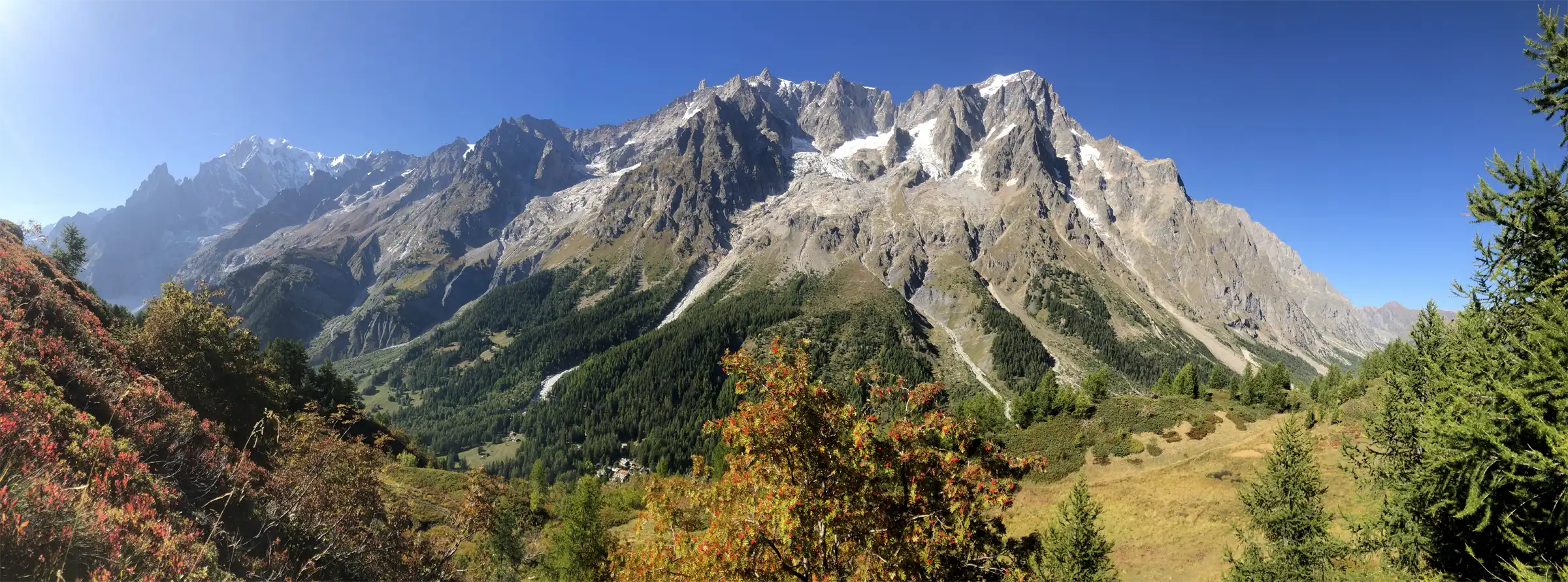
Three countries. Three iconic cheeses. Three iconic wines. One unforgettable adventure.
Every summer, thousands of hikers set off on the Tour du Mont Blanc, one of the world’s most iconic long-distance walks. Most come for the mountains. We completely understand. But along the way, another adventure quietly unfolds—one told through mountain pastures, village dairies and hillside vineyards.
Join us as we follow the trail through three countries, discovering the iconic cheeses and wines that give each stage its own unforgettable flavour.
From early June to mid-September, Chamonix fils with hikers on their way to cross three countries around the majestic Mont-Blanc.
There’s excitement, a touch of nervousness, months of planning, and the quiet anticipation of an adventure they’ve often dreamed about for years.
For us, the evening before setting off has become a tradition in itself.
Maps spread across the table.
A final look at the weather.
One last check that everything has found its place in the backpack.
We used to check the weight going on our backs and inevitably slim down, but now, we know that it allways feels too heavy… So does it realy mater if we cary a little extra cheese?
A fondue maybe, and a bottle of wine…
We’ve walked the Tour du Mont Blanc ourselves many times, usually at the end of the summer when Cheese Forever quietens down a little.
Sometimes I walk while Tom follows on his bike.
Sometimes we shoulder a tent and spend several nights under the stars.
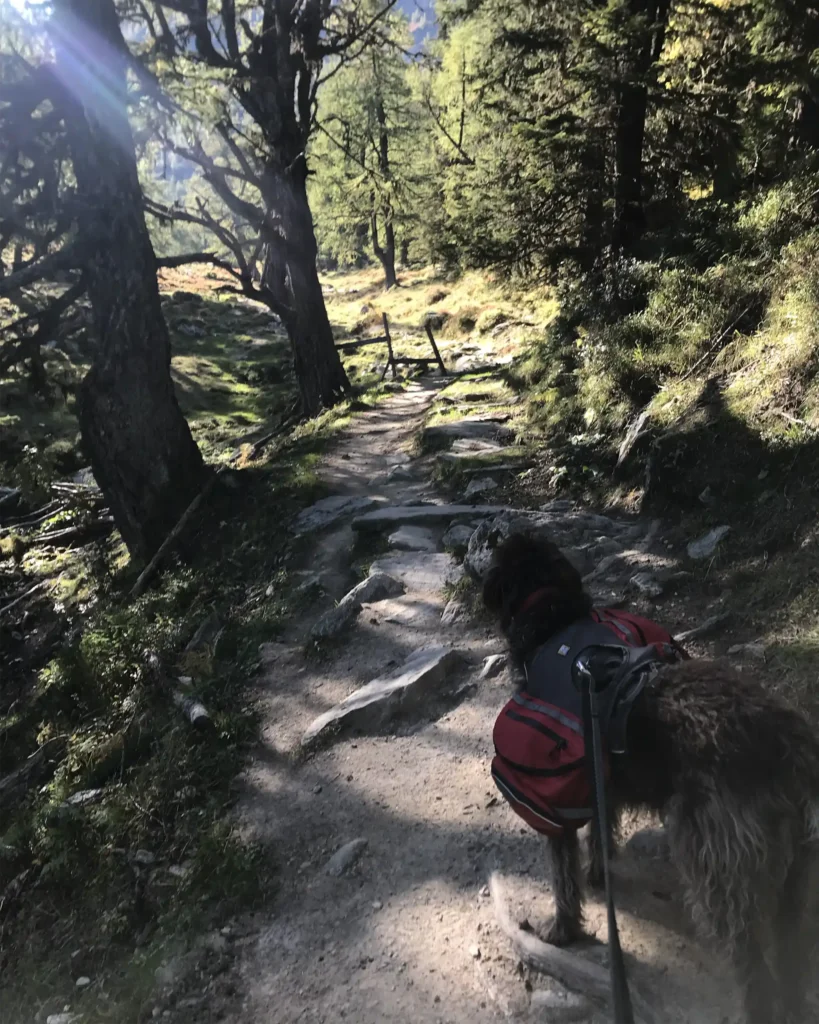
Our dog even has his own little backpack to carry his food.
Each time, we come home reminded that the Tour du Mont Blanc isn’t just a journey through three countries.
It’s a journey through three remarkable Alpine food cultures.
This isn’t a guide to the Tour du Mont Blanc.
There are already plenty of those.
It’s a guide to the flavours you’ll discover along the way.
Chamonix to the Col de la Seigne
The first days of the Tour du Mont Blanc take you somewhere rather special.
Beyond Les Contamines, the trail gradually enters the Beaufortain.
For many hikers, it’s simply another beautiful mountain region, but for us…
It’s one of the great cheese landscapes of Europe.
Because this is where Beaufort truly comes to life.
Not in a cheese shop, not in a cellar.
But right here, on the mountainsides surrounding you.
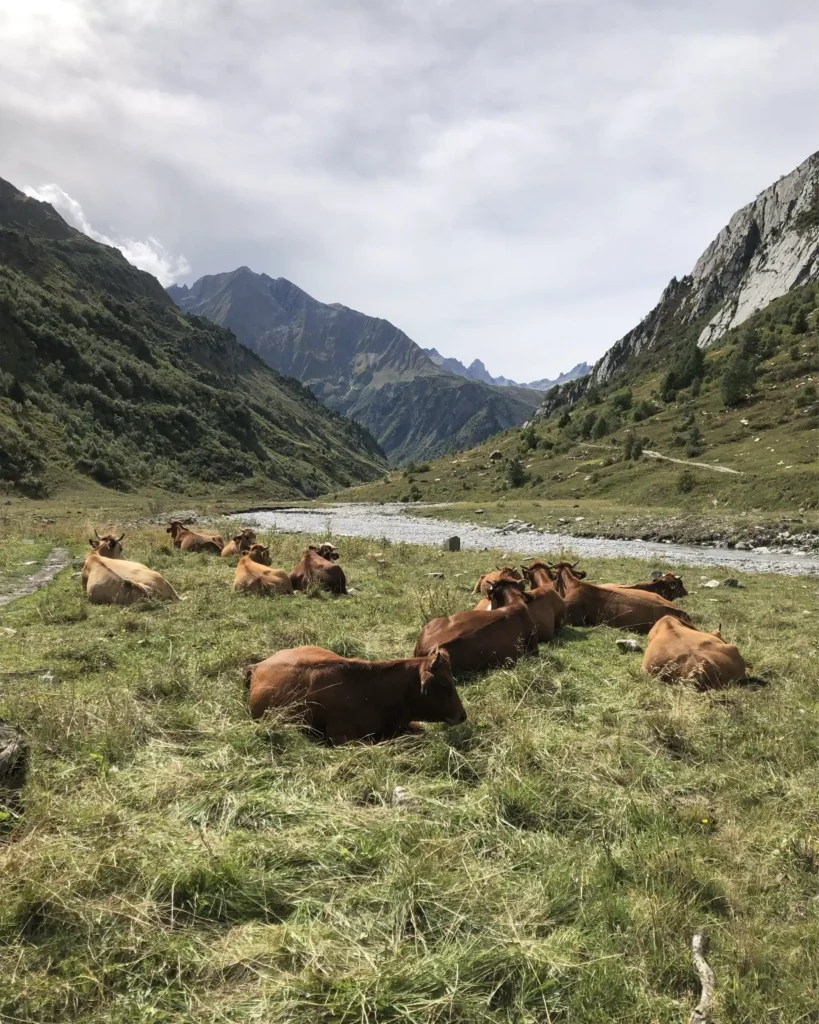
If you keep your eyes open, you’ll notice that the landscape slowly begins to tell the story of the cheese.
The wide alpine pastures, the mountain farms.
The scent of wild flowers carried by the breeze.
And, of course…
The cows.
Lots of them.
Some are Tarines.
Others are Abondances.
Together, they’re the only two breeds allowed to produce Beaufort.
So if you meet a cow somewhere near Les Chapieux…
There’s a very good chance she’s helping to make tomorrow’s Beaufort d’Alpage.
🍷 A little note from Emily
“The first time one of the Abondance cows decided I was standing exactly where she wanted to be…
Let’s just say she won the discussion.
They’re beautiful… but they definitely know who’s in charge.”
😂
— Emily
More than beautiful scenery
One of the things we love most about walking through the Beaufortain is that you don’t simply taste Beaufort later.
You experience it first.
You see the flowers the cows feed on.
You hear their bells echoing across the valley.
You walk through the very pastures that give the cheese its remarkable character.
Suddenly…
The word terroir becomes wonderfully easy to understand.
🇫🇷 France – Beaufort
Known as the Prince of Alpine cheeses, Beaufort has been produced in these mountains for centuries.
Made exclusively from the milk of Tarine and Abondance cows grazing on high summer pastures, it reflects everything that makes Alpine farming so special.
The flowers.
The herbs.
The fresh mountain grasses.
Every wheel captures a little of the landscape you’ve been walking through all day.
If you taste Beaufort while looking across those same pastures…
You’ll understand why terroir is such an important word in France.
🇫🇷 French words you’ll hear…
Terroir
One of those beautiful French words that’s almost impossible to translate.
It isn’t just the soil.
Or the climate.
Or the grass.
It’s the relationship between a place, the people who work there and the food they produce.
If you spend a few days in the Beaufortain…
You’ll understand exactly what it means.
⭐ From the Cheesemonger’s Counter
Beaufort d’Alpage
Not every Beaufort is the same.
The most sought-after wheels are Beaufort d’Alpage, made during the summer months while the cows graze high on the alpine pastures you’ve been walking through.
The richer the mountain flora…
The more expressive the cheese becomes.
It’s one of the purest examples of terroir you’ll ever taste.
The journey continues… even after the cows come down
As summer draws to a close, another journey quietly begins.
The cows leave the high pastures and return to the valleys.
The cheeses begin their own descent.
For centuries, freshly made Beaufort wheels were transported down from the mountain farms, often carried by pack animals along the very valleys you’ve just crossed.
Today, modern vehicles have replaced much of that work, but the rhythm of the mountains remains the same.
Summer in the alpages, winter in the valleys.
And, slowly, patiently…
Months of ageing before each wheel is finally ready.
🍇 From the Wine Counter
Chignin-Bergeron
Strictly speaking, the vineyards lie beyond the Beaufortain rather than on the trail itself.
But if there were one wine capable of capturing the generosity of this first French stage, it would be Chignin-Bergeron.
Made from the Roussanne grape on the sunny slopes of Savoie, it offers ripe stone fruit, mountain herbs and enough freshness to stand proudly beside a mature Beaufort.
Like the cheese itself…
It tastes unmistakably Alpine.
🍷 A little note from Emily
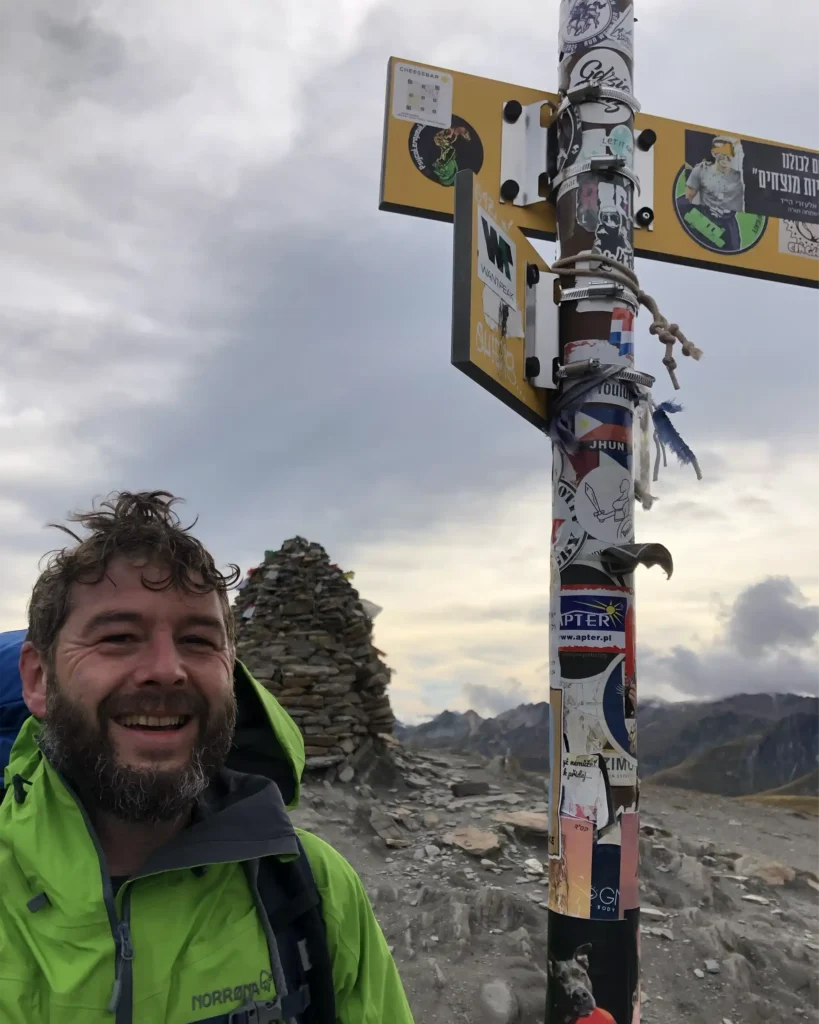
Can you spot our little Cheese Bar sticker?
If you look closely at the photo, you might notice a tiny Cheese Bar sticker hidden among the many hikers’ stickers at the Col de la Croix du Bonhomme.
Let’s just say…
It isn’t the only one we’ve quietly left somewhere along the Tour.
If you happen to find one during your own adventure, we’d genuinely love to hear about it next time you visit us in Chamonix.
Happy hunting!
❤️
— Emily
Crossing into Italy
Reaching the Col de la Seigne feels like crossing more than just a border.
The language changes.
The architecture changes.
Even the light seems a little different.
Yet, in many ways, the mountains remain wonderfully familiar.
The pastures are still alive with cowbells.
The summer meadows are still bursting with wild flowers.
And once again…
The landscape is quietly preparing one of the Alps’ great cheeses.
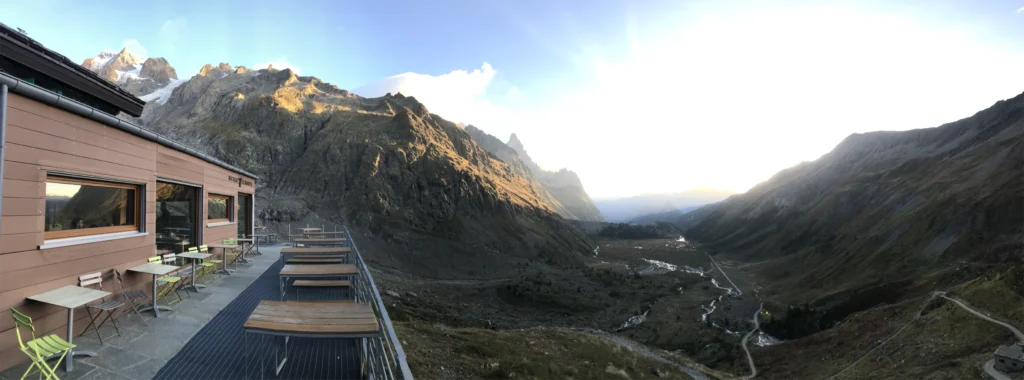
🇮🇹 Italy – Fontina
If Beaufort is the great cheese of the French Alps…
Fontina is undoubtedly its Italian cousin.
Made exclusively in the Aosta Valley from the raw milk of the local Valdostana cows, Fontina has been part of mountain life here for centuries.
It’s softer than Beaufort.
Creamier.
Earthier.
With delicate notes of alpine herbs and fresh milk that seem to capture the very landscape surrounding the trail.
Just like Beaufort…
You don’t really understand Fontina until you’ve walked through the pastures where it begins.
⭐ From the Cheesemonger’s Counter
One valley. One cheese.
True Fontina DOP can only be produced in the Aosta Valley.
Every wheel is made from raw milk collected within hours of milking and matured slowly in cool mountain cellars.
Like all great mountain cheeses…
Patience is one of the ingredients.
🇮🇹 Italian words you’ll hear…
Alpeggio
During the summer months, herds climb to the high mountain pastures known as alpeggi.
It’s the Italian equivalent of the French alpage.
The grass changes.
The flowers change.
And so does the milk.
Courmayeur
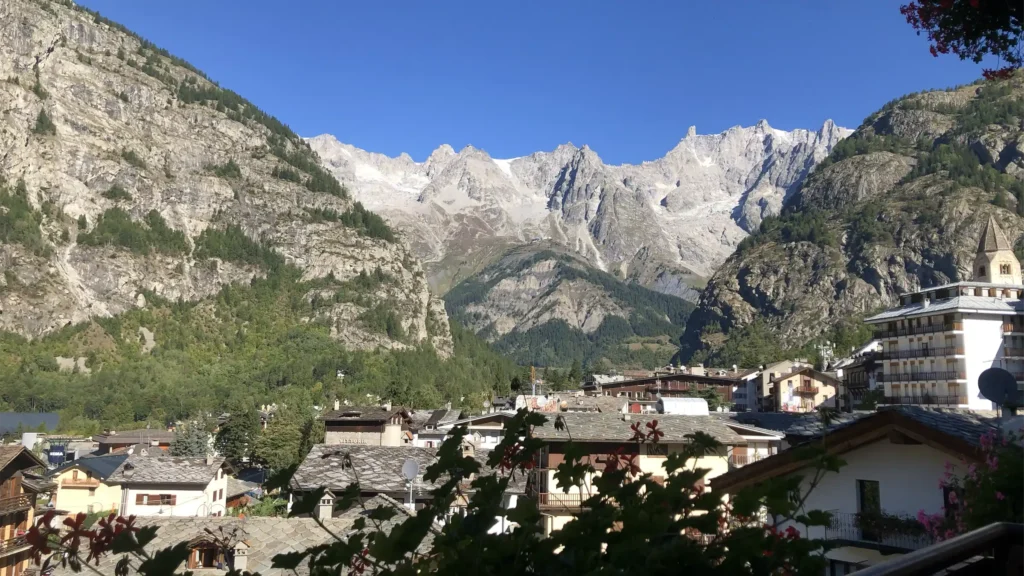
After several nights in mountain huts or beneath a tent, Courmayeur feels almost wonderfully civilised.
Not in an extravagant way.
Simply in that unmistakably Italian way where good food seems to be part of everyday life.
It’s one of our favourite places to slow down, enjoy a proper meal.
Perhaps a good espresso.
Maybe even a glass of wine.
If you’ve been dreaming about fresh pasta for several days…
🍷 A little note from Emily
“Every time we reach Courmayeur, we promise ourselves we’ll only stop for lunch…
Somehow it almost always turns into a rather longer break.”
— Emily
If you enjoy game…
Autumn arrives a little earlier in the mountains.
As the season progresses, many restaurants around Courmayeur begin serving wonderful local game.
Venison, wild boar, sometimes chamois.
Simple mountain cooking at its very best.
If you have the opportunity…
Don’t miss it.
🍇 From the Wine Counter
Torrette
This is where I’d happily reach for a bottle of Torrette.
Made mainly from the indigenous Petit Rouge grape, Torrette combines bright mountain freshness with enough depth to accompany game beautifully.
Young Torrette is vibrant and fruity, and with a few years in bottle, however…
It becomes something quite special.
If you’re enjoying venison after several days on the trail…
A mature Torrette is one of the Alps’ great pleasures.
Climbing towards Bonatti
Leaving Courmayeur behind, the trail begins climbing once again.
It’s a steady ascent.
Sometimes a demanding one.
You’ll probably wonder why you stopped for that second helping of pasta.
Then…
Quite suddenly…
The valley opens.
The Grandes Jorasses rise before you.
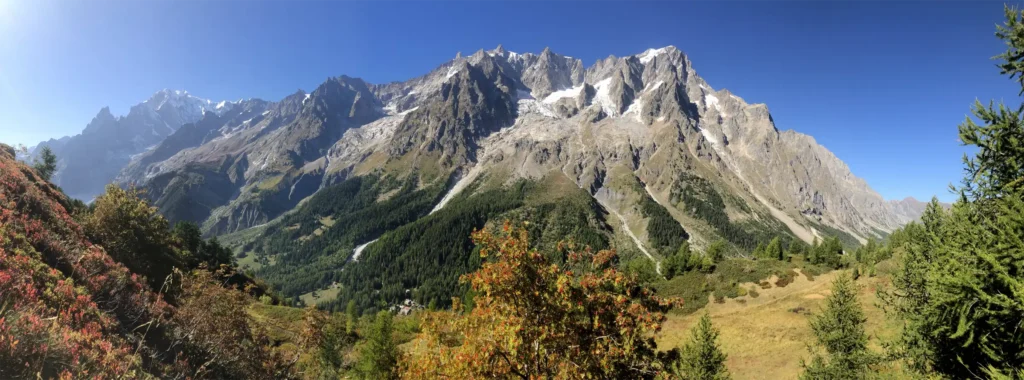
And everything becomes wonderfully quiet again.
For us, this is one of the most beautiful sections of the entire Tour du Mont Blanc.
Not because it’s spectacular.
Although it certainly is.
Because it somehow captures everything we love about the Alps.
Wide open pastures.
Cowbells drifting across the valley.
And enough beauty to make you forget your aching legs.
Into Switzerland
Crossing into Switzerland feels surprisingly different.
The mountains haven’t changed.
The effort certainly hasn’t changed.
Yet somehow…
Everything becomes just a little quieter.
The villages seem almost impossibly tidy.
Wooden chalets perch on sunlit hillsides, with flower boxes overflow beneath every window.
Cowbells drift lazily across the meadows.
If someone asked us to draw the perfect Alpine postcard…
It would probably look a lot like this.
One of our favourite moments comes much later, climbing over the Col de la Forclaz or the Col de la Bovine, depending on the route you’ve chosen.
The scenery is magnificent.
The cows appear blissfully happy.
The views seem endless.
If you’re walking…
You’ll probably stop every few minutes just to admire the landscape.
If you’re riding a bike…
Well…
Let’s just say the climb feels rather less romantic.
🍷 A little note from Emily
“Tom insists the Col de la Bovine is ‘character building’ on a bike.
I’m fairly sure he used rather different words halfway up the climb.” 😂
— Emily
🇨🇭 Switzerland – Le Gruyère AOP
By the time you reach Switzerland, you’ve already crossed hundreds of alpine pastures.
You’ve walked beside countless herds of mountain cows.
You’ve begun to understand that great cheeses don’t simply come from milk.
They come from landscapes.
Gruyère is perhaps the finest expression of that idea.
Made from raw milk and slowly matured for many months, Le Gruyère AOP develops extraordinary depth while remaining beautifully balanced.
Rich.
Nutty.
Elegant.
Comforting.
Like the Swiss landscapes themselves, nothing feels excessive.
Everything feels quietly perfected.
⭐ From the Cheesemonger’s Counter
The cheese with no holes
One of the biggest surprises for many visitors?
Authentic Le Gruyère AOP doesn’t have holes.
Those large holes people often associate with Swiss cheese belong to cheeses such as Emmental.
Gruyère is all about smooth texture, remarkable complexity and months of patient ageing.
Sometimes…
The best-known myths are the easiest to correct.
🇨🇭 Swiss words you’ll hear…
Alpage
Although French is spoken throughout much of western Switzerland, you’ll soon notice familiar words returning.
Alpage once again describes the high summer pastures where cows spend the warm months grazing on Alpine grasses and flowers.
Different country.
Same mountain rhythm.
🍇 From the Wine Counter
Petite Arvine
If Bergeron expresses the generosity of the French Alps…
And Torrette the warmth of the Aosta Valley…
Petite Arvine captures something altogether different.
Precision.
Freshness.
Minerality.
Grown on the dramatic terraced vineyards of the Valais, this remarkable Swiss grape produces wines with vibrant citrus fruit, floral aromas and a distinctive saline finish.
It’s one of those wines that somehow tastes exactly like mountain air feels.
Alongside a well-aged Gruyère…
It’s unforgettable.
Almost home
One of the strange things about the Tour du Mont Blanc is that, as the final kilometres approach, you find yourself feeling two completely opposite emotions.
Part of you can’t wait to get back to Chamonix.
A proper shower.
A real bed.
Perhaps one last glass of wine.
The other part…
Quietly wishes the journey wasn’t ending just yet.
Maybe that’s because, after several days on the trail, something changes.
The mountains begin to feel familiar.
The cowbells become part of the silence.
Even the weight of your backpack somehow seems lighter.
You realise you haven’t just walked around Mont Blanc.
You’ve travelled through three remarkable food cultures, each one shaped by the same mountains in its own unique way.
Back at Cheese Forever
Every Tour du Mont Blanc eventually brings you back to where it began.
Chamonix.
The legs are a little stronger, the backpack is probably a little lighter.
Hopefully…
Your memories are a little richer.
Whenever we finish the Tour ourselves, we always realise that the mountains have given us far more than spectacular views.
They’ve introduced us to remarkable people and traditions.
And some unforgettable cheeses and wines.
That’s exactly why we love welcoming hikers into Cheese Forever.
Not simply to sell a piece of Beaufort or recommend a bottle of Bergeron.
But to continue the conversation.
Sometimes someone comes looking for the Fontina they discovered in Italy.
Sometimes they’re curious to compare it with Beaufort.
Sometimes they simply want one last taste of the Alps before travelling home.
Those are some of our favourite conversations, because somehow, the Tour du Mont Blanc doesn’t really end in Chamonix.
It simply continues around another table.
🍷 A little note from Emily
“One of my favourite questions is always the same…
‘Which cheese did you fall in love with?’
The answer is almost never the one people expected before they started walking.”
— Emily
Frequently Asked Questions
Is the Tour du Mont Blanc suitable for beginners?
The Tour du Mont Blanc is achievable for many hikers with a reasonable level of fitness, but it shouldn’t be underestimated. Depending on the route you choose, you’ll walk for around 7 to 11 days, crossing mountain passes, hiking long distances and dealing with changing weather conditions.
The reward? Some of the most spectacular scenery—and best food—the Alps have to offer.
Which cheese should I try on the Tour du Mont Blanc?
If you only have time for three, make them these:
🧀 Beaufort in France
🧀 Fontina DOP in Italy
🧀 Le Gruyère AOP in Switzerland
Each reflects the landscape, traditions and farming culture of its country.
Can I buy these cheeses in Chamonix?
Absolutely.
At Cheese Forever, we always stock Beaufort, and whenever possible we also offer carefully selected Fontina and Le Gruyère so you can continue your Alpine journey long after you’ve finished the trail.
Which wines should I taste along the way?
If you’d like to discover the flavours of each country, we recommend:
🍷 Chignin-Bergeron (France)
🍷 Torrette (Italy)
🍷 Petite Arvine (Switzerland)
Each tells the story of its own mountain vineyards and pairs beautifully with the local cheeses.
What’s the best time of year to hike the Tour du Mont Blanc?
Most hikers choose late June to September, when mountain huts are open and the high passes are generally free of snow.
If you’re interested in Alpine food, late summer is particularly special. The pastures are still full of grazing cows, local cheeses are at their seasonal best, and villages feel wonderfully alive.
Do I need to book mountain huts in advance?
Yes.
If you’re planning to stay in mountain huts during the summer season, booking several months in advance is highly recommended. The Tour du Mont Blanc has become one of Europe’s most popular long-distance hikes, and accommodation fills up quickly.
Can I hike the Tour du Mont Blanc with a dog?
Yes—but it requires careful planning.
Some mountain huts don’t accept dogs, and a few sections of the trail include ladders or areas where livestock are grazing. Always check each stage beforehand and keep your dog under close control around cattle.
What’s the best way to celebrate finishing the Tour?
A tradThere isn’t one.
Some people head straight home.
Others book a good restaurant.
For us…
Nothing beats sitting down with friends, sharing a great cheese board and raising a glass to an unforgettable journey through the Alps.
Will I ever want to come back?
Probably.
The Tour du Mont Blanc has a habit of drawing people back.
Sometimes it’s a mountain pass you want to see again.
Sometimes it’s a favourite refuge.
Sometimes it’s simply the memory of a remarkable cheese discovered in a tiny Alpine village.
Either way…
Don’t be surprised if you find yourself planning your next Tour before you’ve even unpacked your backpack.
Before you leave…
Planning to celebrate the end of your Tour du Mont Blanc?
Quite often, our clients celebrate the end of the Tour with a glass of Champagne at the Cheese Bar, swapping stories of unexpected snow, memorable mountain huts and those late-night moments of map reading that, somehow, didn’t always go exactly to plan.
No explanation is needed.
They know they’ve earned it…
And so do we.
Just how much that first glass is deserved.
And if you want to take home a piece of Beaufort, discover Fontina for the first time or look for the perfect bottle to remember the Alps, we’d love to help.
Drop by Cheese Forever before you leave Chamonix.
We’ll happily share our favourite cheeses, recommend a few wines and, of course…
Hear all about your adventure!
🧀 Discover more French classics
If you enjoyed this guide, you might also like:
Leave a Reply